
Articles & News
9 Jun Three Tips for Using a Teleprompter in a Business Presentation
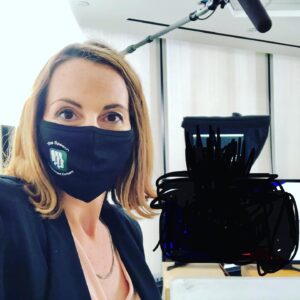 As more and more events become hybrid or completely virtual, the ability to use a teleprompter with ease will enhance the quality of your presentation. Of course, the opposite is also true; fumbling with your script on a screen can make you look panicked, low energy, and under-prepared.
Being a great presenter means you have developed mastery with all the tools at your disposal. When used well, you may utilize a teleprompter at your next event and vow to never go back to improvising your content using only your memory, bullet point notes, or a slide deck as a reference. Teleprompters, when used correctly, should make you look polished, confident, and natural. But once you know you’ll have access to a teleprompter, this is no reason to slack off and slide into the room 20 minutes before the event. Good results with a teleprompter take practice and patience. (more…)
Become a Better Speaker in 30 Minutes

I want to share some advice based on my experience coaching over 200 conference speakers, moderators, and panelists to prepare for their upcoming presentations. Some of the conference speakers I’ve helped just took an initial, free consultation, which is great, others wanted additional, in-depth help for a particularly important event. Some have become valued clients and friends. Regardless of seniority (C-level executives, managers, or individual contributors) or industry such as financial services, fintech, healthcare, biotech, manufacturing, and retail, a few common truths have emerged:
Value – Delivering a message that truly provides value sounds obvious but is difficult without the right focus. Most clients I work with believe they are providing value. Often, that’s not the case. You should explicitly state what the value is to your listeners at the beginning of your presentation. In fact, it should be one clear sentence that says, “this is important to you because…” Also, remember value is not what you think is worthwhile, it’s putting yourself in your listeners’ shoes and deciding what would be valuable to them.
Connection – Connecting with the listeners is easier than you think. Most of my clients believe it’s an innate skill – either they are compelling or not. Not true! Being compelling begins with making sure you are talking to your listeners. If they want you to get to the point, be concise. If they want you to be detailed, start at the beginning and be sure to connect the dots. I often teach a bit about the basics of human reasoning and how communication needs to be inductive or deductive. In either case, I stress that when you speak, it’s not about you! You have important information to present, but if you don’t present it with their perspective in mind, you can forget about being compelling. In fact, it’s possible you won’t be heard at all.
Being Effective – Thinking on your feet and handling challenging questions or unwelcome surprises is an important skill. The good news is, it is easy when you’re well-prepared. You can be ready for the unexpected, whether it’s a last-minute change in the schedule, technical glitches, or dealing with a difficult person. Three steps to good preparate are: 1) have a method to think through upcoming interactions; 2) categorize and catalogue examples and experiences for use; and 3) make this a part of your daily life. When you anticipate and prepare for questions and concerns before you go onto a stage, turn on your camera, or walk into a meeting, you’ll know the right answers and you can focus on the context for your response. If you prepare properly, you will have a critical skill that all effective, persuasive speakers have mastered.
These are only three of the common topics I typically cover, even if it’s a single 30-minute session. Most conference speakers also benefit from tips on dealing with nervousness and practice strategies because like any skill, consistent practice is what gets you to the next level.
I want to help those in need and have learned that in just 30 minutes, we can together take significant steps to make you the best speaker you can be.
18 May THE BASIS OF BIAS AND ATTITUDES

Until the community of police and the communities of color are willing and able to get to the bottom of the biases and attitudes that control behavior, any change will be prolonged and painful. Each person in these communities and others must understand that their behaviors, whether verbal or physical, come from a place in each of us, filled with the attitudes and beliefs that we carry everywhere we go. There are no human exceptions to this fact. It’s as simple as A B C. Attitudes Become Communication. We all have them. We all talk and act the way we do because of them. Sometimes we are readily aware that what we are doing or saying comes from something we believe in. Sometimes we are not overtly aware of why we say or do the things we do. Until each of us can understand what attitudes we carry with us and where they come from, there will be no peace or understanding. A detente will exist and will only erupt again and again. (more…)
11 May The Rudest Things You Can Do During A Work Zoom Meeting
 I don’t consider myself a rude person, and I make great efforts at being polite, self-aware, and apolitical at work. But after reading this article, “The Rudest Things You Can Do During a Work Zoom Meeting,” you may realize, like I did, you’re a bit of a boor online. Fortunately I work with a bunch of great speech coaches here at The Speech Improvement Company, so there’s hope! Now that I’m enlightened, I’m reaching out to all those I’ve offended during my countless and often endless Zoom meetings: I plead ignorance and ask you to give me one more chance.
The Rudest Things You Can Do During A Work Zoom Meeting
Caroline Bologna, HuffPost Work/Life
Etiquette experts share faux pas to avoid in virtual meetings. At this point in the COVID-19 pandemic, you’ve likely used Zoom, Google Hangouts, and other video communications platforms a fair amount. This technology has been particularly prevalent in professional settings as many of us continue to work from home.
But despite all the Zoom experience we’ve gained over the past year, it’s still not uncommon to witness unprofessional or just plain rude behavior in video meetings. From gossiping in chat to appearing in PJs from bed, there’s a lot of room for improvement in the etiquette department.
4 May The Real Reason Remote Workers Are More Productive
 I read an interesting and informative blog post that’s generated a lot of discussions at The Speech Improvement Company.
“Asynchronous Communication: The Real Reason Remote Workers Are More Productive,” appears on the website of Doist, an up-and-coming maker of software-based productivity tools.
The article delves into the productivity of remote workers and how different modes of communication affect it. It includes the following definitions: (more…)
22 Apr Visuals in the Virtual World – A Quick Tip
 Using visuals during presentations is helpful for listeners to connect with your message. They are used to emphasize and clarify speaking points. Has this changed in the virtual world? The short answer is NO. Presenters need to be cautious of having their listeners disconnect from them and their message due to visuals. Whether you are in person or virtual, disconnecting happens. Still, presenters compete for their listeners’ attention with so many more distractions in a virtual world. Why is the dog barking, who is ringing my door, why is my child texting me are just a few examples of what listeners are thinking now that they are working from home. (more…)
15 Apr Five Strategies to Demonstrate Gravitas

‘Gravitas’ was one of the ancient Roman virtues that denoted “seriousness.” Also translated as weight, dignity, and importance, it conveys a sense of responsibility and commitment to the task. In our modern society, gravitas indicates polish, grace in manner, and dignity in outward appearance. I’m guessing that speaking while on mute would not be considered speaking with grace and dignity!
In executive communication coaching, gravitas is often mentioned. Executives with gravitas are considered to have ‘weight,’ ‘authority,’ and ‘executive presence.’ They’re taken seriously and thought to have leadership qualities. As an Executive Communication Coach, I often observe people speaking with sentences that fade away or using a flat inflection. They do this purposefully with the mistaken idea that you must always be serious or low energy to have gravitas. We’ve come a long way from Roman times, where seriousness was the primary way to demonstrate gravitas. These inaccurate stereotypes can diminish your ability to demonstrate leadership and authority in your current role. (more…)
6 Apr Having “the Talk” with Clients
 As a coach, we meet all kinds of people who want to become better public speakers and communicators. Most of them are keen to learn, try new things, and some need a little friendly push now and then to keep going.
But what happens when the client refuses to communicate or shuts down? Some signs of trouble with the client could include missing appointments with no notice, not doing practice or assignments between meetings, or if they do meet, they have very little to say. (more…)
30 Mar The trials and tribulations of working from home are many
 At first, I thought this is great! I will work from home! I will be able to cook dinner and spend some quality time with my family. Well, it’s been two weeks, and I have learned a great deal. Working from home is hard, especially when your spouse or significant other is also attempting to do it as well. My bedroom has become my office since my husband took over our entire kitchen /dining room. What I didn’t anticipate was having to establish perimeters for each of us. If I had thoroughly thought this thru, then I would have suggested the following: (more…)
Free Webinar: Controlling Nervousness Before Speaking – April 14, 2021
 Learn how to control nervousness associated with public speaking with this free, 30-minute webinar hosted by The Speech Improvement Company.
Whether you call it ’nervousness” or “anxiety’ or “fear of speaking,” it is a widespread experience for many people worldwide; you are not alone. The good news is that it can be controlled. This complimentary webinar will discuss the ‘real causes’ of this experience and some tools and techniques to control the nervousness.
Wed, April 14, 2021
2:00 PM – 2:30 PM EDT
22 Mar Why Listening is Difficult
 It’s often been said that humans have two ears and one mouth in order to listen twice as much as we speak. Interestingly, almost all research points to the veracity of this statement.
Related: Listening: Our Most Used Communications Skill | MU Extension
We do listen much more than we speak. Yet, it is rare to find an institution of learning from K – 12 and beyond that provides any programs or even classes in listening. This truism is a national shame for those who design curriculum. (more…)
10 Mar Dr. Dennis Becker @ World Speech Day
 Dr. Dennis Becker, founder of The Speech Improvement Company, was chosen to represent North America at World Speech Day scheduled for March 15, 2021. The honor was given to him in recognition of his stature as a worldwide expert in human communication.
World Speech Day is a day to celebrate speeches and speechmaking that change the world – socially, politically, in the arts, business, and religion. This is their sixth year and feature a Master Class of speakers from 100+ countries delivering speeches and taking questions from viewers and listeners.
Dennis’ planned, 15-minute live-streamed speech is entitled “What has a Worldwide Pandemic Done to Public Speaking?” His comfortable and “shirtsleeve” English style will benefit viewers and listeners across the globe.
5 Jan Topic of the day: Video Cover Letters

It’s no secret 2020 was a challenging year in many ways. As most of us look forward to putting this year behind us, many companies may be gearing up for new year hiring as new budgets come into play in early 2021.
This brings up the relatively new idea of a video cover letter. What is a VCL, you ask? It’s just like it sounds, it’s you, talking about you and your skills, and is sent to a hiring authority at a company you wish to work for along with your CV or resume.
What are the upsides of a VCL? From a speech coach’s point of view, there are benefits and risks. For example, if you say that you have excellent communication skills, your VCL should make those evident. A warm smile, a clearly-worded, and articulate script should also be evident. Having a great voice tone, eye contact with the camera, and good posture as well as fresh, clean clothes all can carry the day. (more…)
Give Me a Break! Tips to Promote Team Morale and Sanity

As we all continue to adapt to our remote workplace in 2021, coaches find that our clients confide worries and challenges about virtual meetings to us.
So, meeting leaders, here are easy ways to enhance your team’s morale and productivity :
- Give them a break. Some team members feel like it’s a luxury to visit their own bathroom or grab a yogurt, as close as they may be. Encourage 15-minute breaks every ninety minutes or two hours and discourage back to back meetings. Speaking of meetings…
- Make it easy to ask questions. Team members miss informal chatter, laughs, and learning from others just by hanging out. One financial analyst shared that he avoids asking his manager a simple question since it seems “so formal” to schedule a call.
- Remember that fun builds trust. Make time for rituals and some crazy moments. Getting those positive hormones going is bonding—and bonding builds morale. Back in November, I asked a bank CIO to share the highlight of his past week. The enthusiasm in his voice and body language was better than ever when he shared that he organized a Halloween costume contest. This C- Suite Dracula had forty team members enter with just a day’s notice.
30 Dec Five New Ways to Combat Remote Team Loneliness During Coronavirus
Studies show that loneliness is becoming an increasingly common physical and mental health concern for which remote workers are acutely at risk. With coronavirus forcing employees into 100% work from home (WFH) guidelines, and in some cases, complete shelter in place restrictions, workplace loneliness is at an all-time high.
Understandably, employees who are used to seeing each other every day are especially feeling this disconnect. And, with coffee shops and restaurants closed, remote employees who were always 100% remote no longer have their routines those routines.
23 Nov Five Tips for Communicating In A Mask

Facial coverings and masks can make it difficult for some people to communicate. People who often rely on facial cues may not understand you when your face is covered, or your voice is muffled. As an Executive Coach, I have seen how it can be hard to talk to neighbors, friends, co-workers, and family while wearing a mask.
When you are wearing a face-covering to help prevent the spread of COVID-19, be aware that you may inadvertently create a situation where another person may no longer understand you. Remember, how you communicate is just as important as what you communicate.
Here are five tips for communicating when using face coverings and masks:
1.Use Active Body Language
Body language, hand gestures, and posture are most important. Your non-verbal cues should reflect the tone and theme of your content. Nod when appropriate to acknowledge you are listening and understanding.Focus on
2. Eye Contact
Use your eyes and eyebrows. Good eye contact is critical. Let your eyebrows tell the story. Happiness can be seen by raised eyebrows, raised cheeks, and crow’s feet. Eyebrows pinched together can sometimes convey anger or frustration, so remember that your eyebrows are part of your eye contact when wearing a mask.
3. Adjust Your Voice Tone
Your tone of voice includes your inflection, rate, and pace, which can be equally as impactful as your speaking words. Articulate loudly and clearly, without shouting.
4. Look at Alternatives
If using a mask is a serious barrier to speaking and having others understand you, consider a face shield or a see-through face mask.
5. Send a Post-Conversation Summary
Consider using a written recap of the conversation, so nothing is lost. This could mean a quick recap email, a text, a short PowerPoint deck, or a formal document that summarizes what you shared.
As we begin to wrap up 2020, let’s keep masks on and spirits up. We can do this. Thanks for helping to keep everyone safe.