
Sales tips from Dikram Husseindjian

Dikram Husseindjian is a former VP of Sales at Apple Inc, Canada.

Dikram is now senior partner at Embrase a consulting firm in Montreal, QC. “For the past eight years he was National Sales Manager at Apple Canada, leading the sales team to top performance in revenue and profitability growth. Prior to joining the information technology sector, he spent 5 years in marketing and product management in the manufacturing sector for companies that include Honeywell, Bristol-Meyers and Hunter Douglas.”

He was invited by iNovia Capital and gave a one-hour long presentation on sales strategies.

One of the mistakes Dikram says sales representatives make, is that they keep the CEO of the company they are trying to sell to, involved throughout the sales process.

While Dikram says that a sales representative should start to enter as high as possible, including CEO level, he recommends that after this initial step, the CEO be not involved with details in the middle parts of the sales process. Instead, he should be called again in the closing stages of the process.

The sales process itself is composed of six steps:

Discovery -> Qualifying -> Evaluating -> Decision -> Purchase-> Deploy

Throughout this process, three key variables will have varying degrees of importance.

Solution Fit: critical at first but decreases in importance.

Price: important at the beginning and end of the process.

Risk: rises for the potential purchaser as time passes.

In short, sales is about strategy and formalising procedures rather than a series of improvisations.
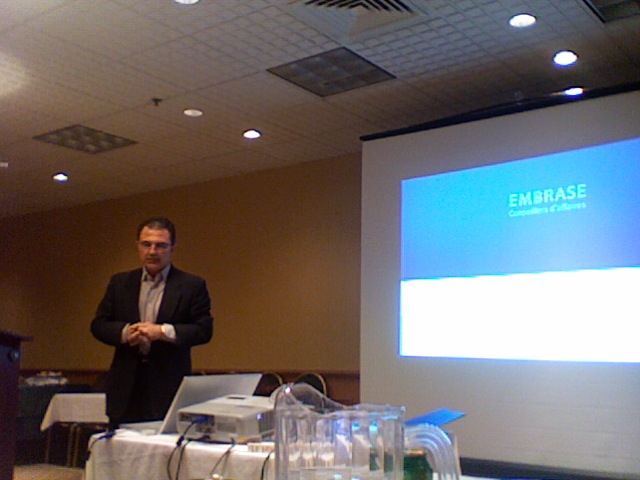
Dikram Husseindjian is a partner at Embrase.com

Author

Spread the love

Authors

MORE POSTS

What’s Wrong With Our Communication?

“We need to work on our communication skills.” “We have a communication problem.” “We need to fix our communication.” As an expert at the intersection of people/organizations and communication for over 20 years, I have heard these comments many times. But what does it mean to solve communication problems, or to make the communication in your company “better”? To share information about a major change successfully? To manage that one employee who can’t get along

Spread the love

The Terrain Informs the Technique

In executive coaching, you hear a lot of singular techniques — one framework, one mindset, one magic fix that’s supposed to solve everything. In reality, even the best techniques only work when they adapt to the terrain. The central lesson is simple: knowing not just what to do, but when and why to do it. It’s the difference between approach and technique, strategy and tactic. When I run in the mountains, I shorten my stride whether I’m going uphill or downhill, but for entirely different reasons.

Spread the love
group of business people communicating effectively

How Important Is That Impression to Meeting Your Goal?

How often do you think about your goal when you prepare for a high-stakes interaction? Is selling your company or product the goal? Are you looking to connect with potential partners or purchasers? Are you looking to build your personal brand and move upward in your career? Do you want to become a thought leader? Are you hoping to raise visibility for your company? Do you want to educate people about what your product can

Spread the love

QUESTIONS? NEED HELP?

Tell us what’s on your mind: